Valid Affidavit Form
At the crossroads of personal declarations and legal proceedings, the affidavit form stands as a crucial document that brings an individual's statement under the oath of truthfulness before the law. Serving multiple purposes, this form is often required in court cases, property transactions, and various other situations where a written statement needs legal backing. It is structured to ensure that the person making the declaration, known as the affiant, provides a clear and factual account of their knowledge or belief concerning a particular matter. The integrity of this document is upheld by the requirement for it to be signed in the presence of a notary public or an authorized officer, adding a level of legal formality and seriousness. The versatility and binding nature of an affidavit make it a fundamental element in a wide array of judicial and administrative processes, highlighting its importance in both enforcing legal obligations and protecting individual rights.
Affidavit Form Categories
- Affidavit for Death Certificate
- Affidavit of Bona Fide Marriage
- Affidavit of Permanent Fixture
- Affidavit of Small Estate
- Amendment Affidavit
- Birth Affidavit
- DMV Affidavit of Non-Use
- Free to Marry Statement
- Gift Declaration Affidavit
- Identity Affidavit
- Permanent Address Affidavit
- Proof of Residence
- Proof of Service Affidavit
- Self-Validating Affidavit
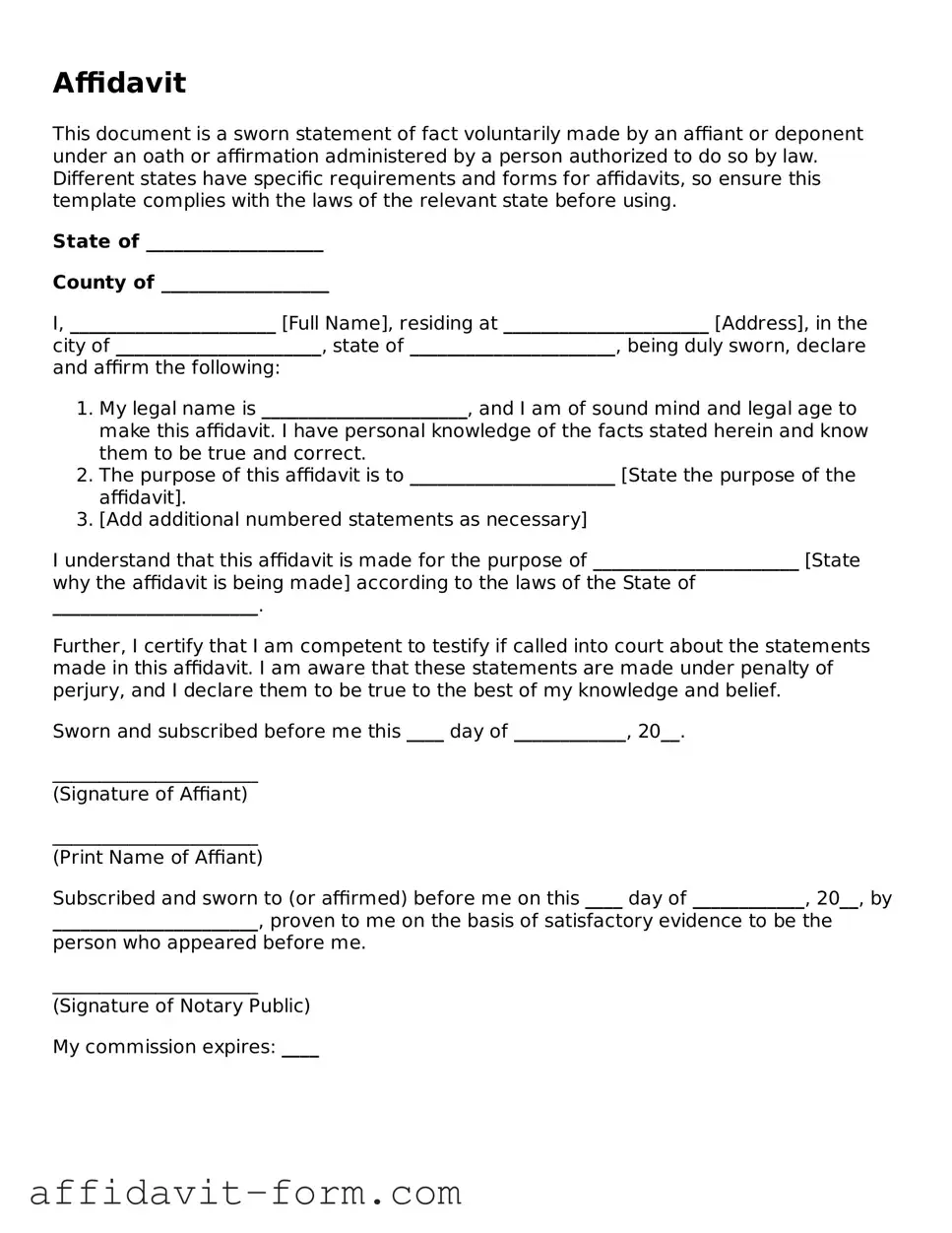
Form Example
Affidavit
This document is a sworn statement of fact voluntarily made by an affiant or deponent under an oath or affirmation administered by a person authorized to do so by law. Different states have specific requirements and forms for affidavits, so ensure this template complies with the laws of the relevant state before using.
State of ___________________
County of __________________
I, ______________________ [Full Name], residing at ______________________ [Address], in the city of ______________________, state of ______________________, being duly sworn, declare and affirm the following:
- My legal name is ______________________, and I am of sound mind and legal age to make this affidavit. I have personal knowledge of the facts stated herein and know them to be true and correct.
- The purpose of this affidavit is to ______________________ [State the purpose of the affidavit].
- [Add additional numbered statements as necessary]
I understand that this affidavit is made for the purpose of ______________________ [State why the affidavit is being made] according to the laws of the State of ______________________.
Further, I certify that I am competent to testify if called into court about the statements made in this affidavit. I am aware that these statements are made under penalty of perjury, and I declare them to be true to the best of my knowledge and belief.
Sworn and subscribed before me this ____ day of ____________, 20__.
______________________
(Signature of Affiant)
______________________
(Print Name of Affiant)
Subscribed and sworn to (or affirmed) before me on this ____ day of ____________, 20__, by ______________________, proven to me on the basis of satisfactory evidence to be the person who appeared before me.
______________________
(Signature of Notary Public)
My commission expires: ____
Document Details
| Fact | Description |
|---|---|
| Purpose | An affidavit form is used to make a sworn statement or declaration under penalty of perjury. |
| Components | Typically includes a statement of facts, the affiant’s signature, and a jurat or acknowledgment by a notary public. |
| Legal Standing | Once signed, it serves as evidence in court and other legal proceedings. |
| State-Specific Forms | Requirements and formats can vary by state, impacting the form’s content and execution process. |
| Governing Law | Each state has its own laws governing the use and recognition of affidavits, often found within that state's codes of civil procedure. |
| Notarization | Notarization is a common requirement, formalizing the authenticity of the affiant’s signature. |
| Uses | Used in a multitude of settings, from legal disputes to financial transactions and estate planning. |
| Accessibility | Forms can typically be obtained from legal professionals, courts, online resources, or state-specific government websites. |
| Amendments | If errors are discovered or updates are needed, an affidavit may need to be re-executed with the correct information. |
How to Use Affidavit
Filling out an affidavit form is a straightforward process that plays a crucial role in various legal scenarios. Once completed, this document will assert that your statements are true to the best of your knowledge, under penalty of perjury. It’s a powerful tool in lending credibility to your words in legal matters. Knowing how to accurately complete this form is essential, as any discrepancies or inaccuracies could have significant consequences.
Here’s how to fill out the affidavit form correctly:
- Gather all necessary information pertaining to the statement you intend to make. This might include dates, locations, names of individuals involved, and any relevant details that support your declaration.
- Identify the affidavit form required for your particular situation. This could vary based on jurisdiction or the nature of the affidavit. Ensure you have the correct form before you start.
- Begin by entering your full legal name, address, and other requested identifying information at the top of the form. Ensure accuracy as this identifies you as the affiant.
- State your facts clearly in the body of the affidavit. It’s crucial to be concise and to the point. Number each statement or paragraph for clarity, making sure each fact is a separate item.
- If applicable, insert a section for your oath, stating you swear or affirm the information provided is true. This is where you legally assert the truthfulness of your statements.
Once the affidavit form is filled out and notarized, it becomes a binding legal document. You may be required to submit this document to the relevant authorities or legal bodies, depending on its intended use. Moving forward, it's important to understand that this affidavit may be used in legal proceedings, and as such, honesty and accuracy cannot be overstated. Falsifying an affidavit can result in legal penalties, including perjury charges, so it’s vital to ensure that all information provided is truthful and accurate to the best of your knowledge.